Entry No. 181 · The Long Game
What You Planted in Spring
A Backyard Brew Story
By Ryan Khalil (R.Solace) · September 15, 2026 · 7 min read
My boys,
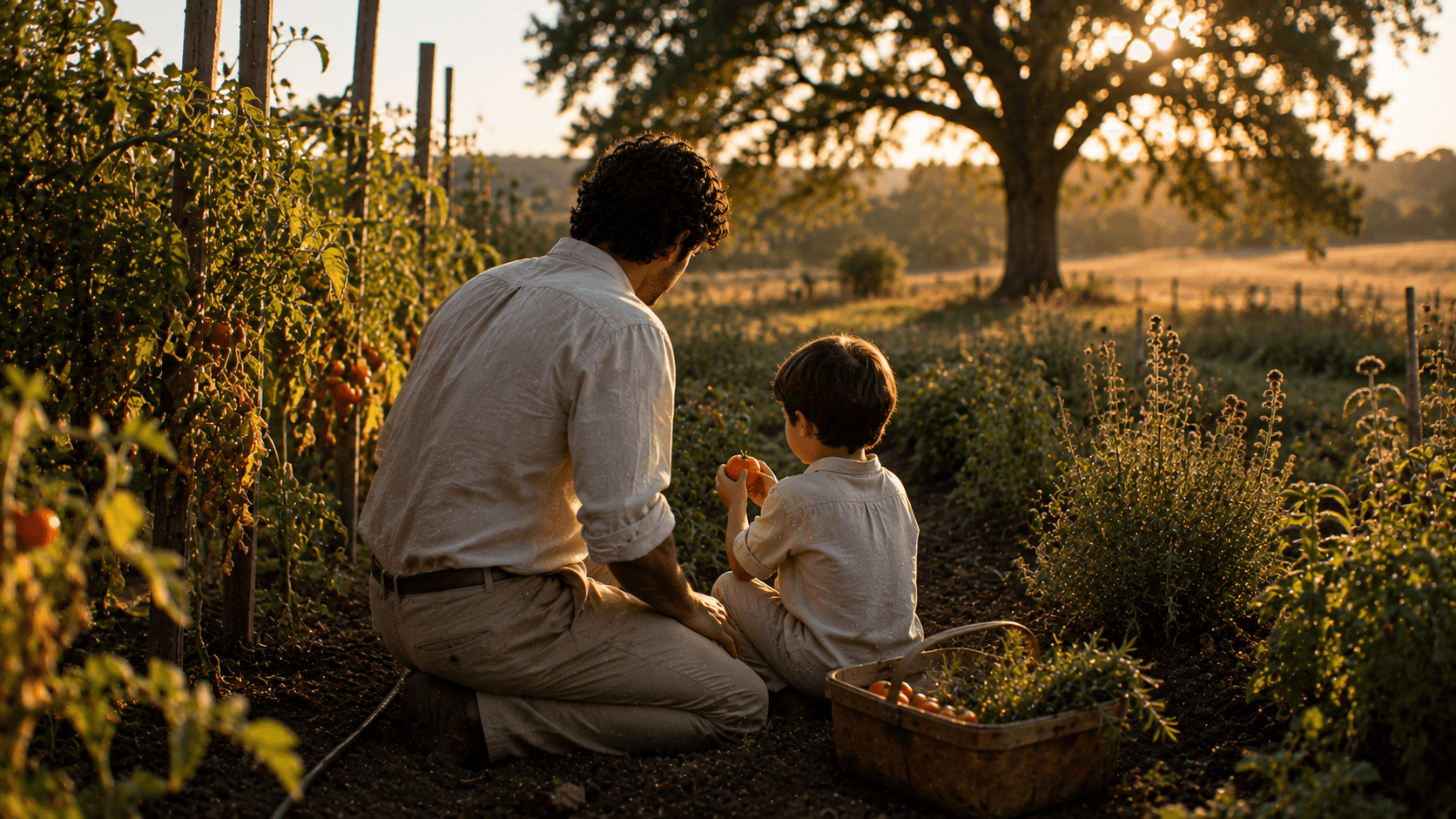
We were outside when one of you noticed the tomatoes.
Not the first tomatoes of the year. By September, the excitement had mostly worn off. The vines were messy, some leaves had browned around the edges, and the garden looked nothing like the clean rows we had started with months earlier.
You reached through the leaves and pulled one free.
"Did we grow this?"
"Yeah," I said. "Remember when we planted them?"
You looked at the tomato, then at the garden.
"I don't remember planting this one."
I laughed.
"You didn't plant the tomato. You planted the seed."
You thought about that for a second.
Then you asked,
"How did the seed know how to make a tomato?"
I started answering like an adult.
Sunlight.
Water.
Soil.
Roots.
All the mechanisms we use to explain something without necessarily explaining it.
You listened.
Then you asked,
"But how did it know?"
That was the better question.
I didn't have a better answer.
So I told you the truth.
"I don't know, buddy. God made it know."
You seemed perfectly satisfied with that.
I wasn't.
I stood there afterward looking at that garden and thinking about how much of life works exactly like this.
We like to believe we understand the harvest because we participated in the planting.
We put something in the ground.
We watered it.
We pulled weeds.
We showed up.
Then something appears months or years later and we begin speaking as though we manufactured the miracle.
But we didn't make the seed open.
We didn't instruct the roots where to go.
We didn't tell the flower when to become fruit.
We participated.
That is different.
I have planted a lot of things in my life.
Businesses.
Ideas.
Relationships.
Habits.
Mistakes.
Promises.
Some grew quickly.
Some never came up.
Some produced something completely different from what I thought I was planting.
And some things I planted so long ago that when the harvest finally arrived, I had almost forgotten where it began.
That is why your question stayed with me.
How did the seed know?
Maybe one of the dangers of becoming successful at anything is forgetting how much you do not control.
You can prepare the soil.
You can plant carefully.
You can water faithfully.
You can protect what is growing.
That is your work.
But there is a point beneath the soil where your hands cannot reach.
That part belongs to God.
I find that comforting now.
It means I am responsible for faithfulness, not omnipotence.
I do not have to force everything to grow.
Neither do you.
Plant well.
Tend carefully.
Be patient.
And when something finally ripens in your hands, resist the temptation to look at it only as proof of what you accomplished.
Remember the seed.
Remember the rain you did not make.
Remember the sunlight you did not turn on.
Remember the thousand invisible things that had to go right while you were somewhere else living your life.
Then say thank you.
That afternoon, we took the tomato inside.
You wanted to eat it immediately.
So we did.
No ceremony.
A little salt.
Juice running down your fingers.
You took another bite and said,
"We should plant more."
That may have been the second-best thing you said all day.
I love you.
— Baba
Question:
When you look at what has grown in your life, do you only remember your labor, or do you remember everything you could never have made happen yourself?
Moral:
We are responsible for planting and tending what God places in our hands. The growth itself should keep us humble. Harvest is not only evidence of labor. It is an invitation to gratitude.
This story reflects real experiences and philosophies behind Backyard Brew. It is shared to inspire perspective and intention.
Author: R. Solace
This story is a real lesson learned by Ryan Khalil. AI was used to help organize and structure the stories you're reading. The intent of these stories is to help, not to hurt.
The newsletter
One idea, told well, every so often. No hype, no selling — just the work. Unsubscribe anytime.
subscribe