Entry No. 230 · The Long Game
The Long Evenings Are a Gift
A Backyard Brew Story
By Ryan Khalil (R.Solace) · November 3, 2026 · 14 min read
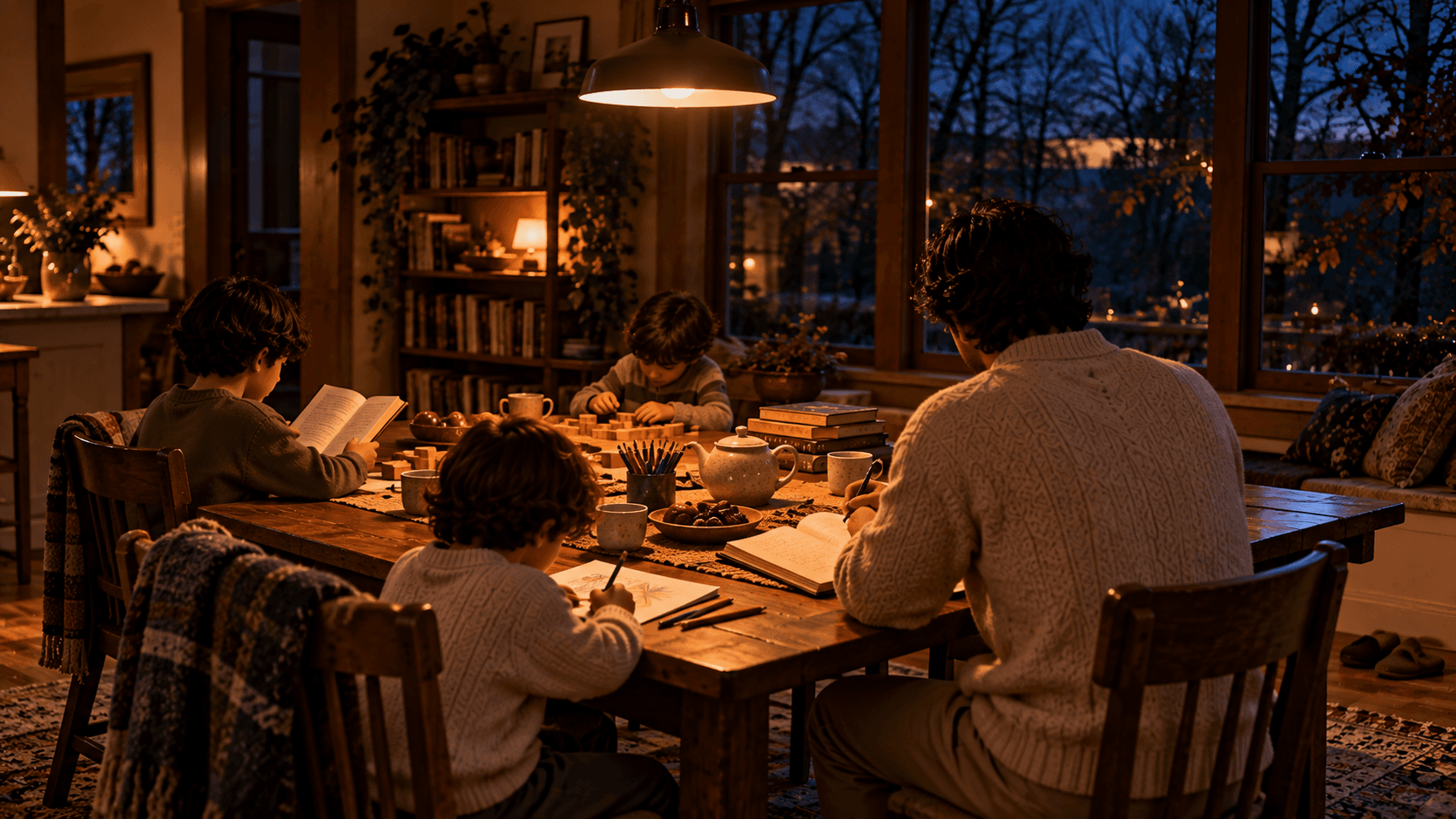
My boys,
Every November, I hear the same complaint.
"The days are getting too short."
"It's dark before dinner."
"I feel like the whole day is gone."
I understand.
I have said those things myself.
But I have started to believe we are looking at the season backward.
The days are shorter.
The evenings are longer.
And I think the long evenings might be some of the best hours of the year.
If a man knows what to do with them.
Let me explain.
During the summer, the world is always asking something of you.
There is grass to cut.
A garden to tend.
A project waiting outside.
Another place to go.
Another hour of sunlight that feels too valuable to waste.
You finish dinner and look out the window.
Still light.
So you get up again.
There is something beautiful about that.
But there is also a cost.
When the world keeps offering more daylight, it becomes difficult to recognize when you have done enough.
November changes the arrangement.
The yard goes dark.
The tools go away.
The garden rests.
The windows become mirrors.
And suddenly the outside world stops making so many demands.
That is not a punishment.
That is an opportunity.
First, the long evenings give you your family back.
Not because summer takes them away.
Because summer makes it easier for everyone to scatter.
One person outside.
Another riding a bicycle.
Someone visiting a neighbor.
Someone finding one more thing to do.
But when the cold settles in and darkness comes early, the house begins collecting its people.
There is time to sit together.
Not for a special occasion.
Not because someone planned an activity.
Just because everyone is home.
And that matters more than we realize.
Children do not always remember the impressive things you arrange for them.
Sometimes they remember the ordinary evenings.
The same chair.
The same blanket.
The same silly conversation.
The way their father listened while they explained something that made absolutely no sense to him.
The feeling that nobody was in a hurry to leave.
You cannot purchase that kind of memory.
You have to be present long enough for it to form.
Second, the long evenings give you time to become better at something.
A man complains that he has no time to read.
Then November gives him three quiet hours and he spends them scrolling through other people's lives.
He says he wants to learn another language.
Become stronger.
Understand his faith.
Write.
Build a skill.
Repair a relationship.
Yet when the evening becomes available, he treats the silence like a problem that needs entertainment.
I have done this too.
It is easy to mistake distraction for rest.
They are not the same.
An evening spent consuming everything the world offers can leave you more tired than an evening spent making something of your own.
Read ten pages.
Learn a few words.
Write a letter.
Stretch.
Study.
Sit with your children and teach them something useful.
A hundred ordinary evenings can change a man.
Not because any one of them is extraordinary.
Because he keeps returning to the same worthwhile things.
Third, the long evenings give you permission to rest.
And this may be the hardest gift for a man like me to accept.
I know how to work.
I know how to begin another project.
I know how to convince myself that if I am capable of doing something, I should probably be doing it.
But I am learning that capability is not an obligation to remain in motion.
A man can be disciplined and still sit down.
He can be ambitious and still enjoy dinner.
He can be responsible and still leave tomorrow's work for tomorrow.
Rest is not the opposite of purpose.
Sometimes it is what allows purpose to survive.
God did not make us creatures who can work endlessly without consequence.
Our bodies need recovery.
Our minds need quiet.
Our hearts need space.
And the people we love need to experience us as more than men who are always occupied.
Fourth, the long evenings make room for conversations that daylight often interrupts.
The first ten minutes at the table are usually ordinary.
How was your day?
Did you finish your homework?
What happened at school?
Who left this cup here?
But stay long enough and something changes.
Someone asks a real question.
Someone admits they are worried.
A boy tells his father something he has been carrying all day.
A brother says something funny and suddenly everyone is laughing.
A conversation wanders somewhere nobody intended.
Those moments cannot always be scheduled.
They need unhurried time.
You cannot demand that someone open his heart at six-thirty because you have seven minutes available.
You make room.
You stay.
You listen.
And sometimes, when nothing is being forced, the important thing finally gets said.
Fifth, the long evenings teach you how to be alone.
This matters too.
There will be evenings when the house is quiet.
When nobody needs you.
When the phone does not ring.
When the work is finished.
And you are left with yourself.
Some men cannot tolerate that.
They need noise.
Company.
Entertainment.
A problem to solve.
Anything to avoid sitting with their own thoughts.
But solitude is not necessarily loneliness.
Sometimes it is where a man finally hears himself clearly.
Where he recognizes what has been troubling him.
Where he admits what needs to change.
Where he remembers to thank God without asking for anything.
Where he discovers that peace does not always require another person to provide it.
Learn to enjoy your own company.
It will make you better company for others.
And finally, the long evenings teach us something about enough.
Summer says there is more.
More daylight.
More activity.
More opportunity.
More things to do before the sun disappears.
November asks a quieter question.
What if what is already here is enough for tonight?
The food on the table.
The people in the house.
A book.
A warm room.
A prayer.
A conversation.
A body that has worked and is ready to rest.
What if an evening does not need to become memorable to be valuable?
What if being alive inside it is already worth something?
My boys,
I do not want you to become men who spend half the year wishing for the other half.
There will be time for long summer evenings again.
Time for open windows.
For gardens.
For work that stretches toward sunset.
For the world to open outward.
But that is not this season.
This season has its own gifts.
And you will miss them if you spend every evening resenting the dark.
So when November arrives and someone complains that the sun is gone by five, I hope you remember this.
The daylight may be shorter.
But the evening has not been taken from you.
It has been placed in your hands.
You can waste it.
You can fear it.
You can fill it with noise until you no longer notice it.
Or you can use it to become the kind of man who knows how to live when the world grows quiet.
Come home.
Eat something good.
Pray.
Learn.
Laugh.
Listen.
Rest.
Be present.
Let the world outside go dark without believing something important has been lost.
Because sometimes the best part of the day begins when the sun goes down.
I love you.
— Baba
Question:
If you treated the next hundred long evenings as a gift instead of an inconvenience, what could you build, deepen, or restore with them?
Moral:
Shorter days do not mean smaller lives. The long evenings offer time for family, learning, faith, rest, conversation, and contentment. What matters is not how much daylight remains, but what you choose to do with the hours you are given.
This story reflects real experiences and philosophies behind Backyard Brew. It is shared to preserve perspective, family, discipline, faith, contentment, and intention.
Author: R. Solace
Pass it on
This story is a real lesson learned by Ryan Khalil. AI was used to help organize and structure the stories you're reading. The intent of these stories is to help, not to hurt.
The newsletter
One idea, told well, every so often. No hype, no selling — just the work. Unsubscribe anytime.
subscribe